

Do Electric Kettles Save Money? Efficiency & Routine Guide

Your morning starts with the same routine. You fill a pot with water and wait a long time for it to boil. Several minutes pass, steam rises, and you glance at your watch. Meanwhile, your coffee gets cold before the hot water is even ready.
But an electric kettle can change all that. It boils water for your morning coffee in less than three minutes*. You press a button, and the kettle switches off automatically without any extra effort. A good kettle makes your mornings much easier.
The benefits of a kettle aren’t limited to just speed. An electric kettle uses less electricity and also makes your kitchen safer. Fast and easy-to-use kitchen appliances for your busy lifestyle. That’s why millions of families in the UK now choose electric kettles over traditional stovetops.
This guide from BestElectricKettles explains how an electric kettle saves you time and money, backed by real data and practical examples.
How Much Money Does an Electric Kettle Actually Save?
The financial case for an electric kettle is straightforward. It uses less energy than boiling water on a gas stove.
Research shows that an electric kettle can boil three litres of water using the same amount of energy a gas stove needs for just one litre. This efficiency gap widens the more water you boil. For 100 millilitres, both methods take similar energy. At one litre, the electric kettle uses 0.16 kilowatt-hours less energy than a gas stove.
Looking at it in monetary terms: if you boil water every day using an electric kettle instead of a gas stove, you could save between three and seven pounds a year. Although this saving may seem small on paper, if you look at it in terms of one house over five years, you could save between fifteen and thirty-five pounds.
If you live in a place in the UK where electricity is expensive or gas is cheap, the actual savings increase, making the gap even smaller. When electricity is cheap and gas is expensive – which is true in many areas like Hungary or Malta – your annual savings can double.
Why Electric Kettles Use Less Energy?
Electric kettles are Energy Efficient, and the reason is simple physics. An electric kettle heats water directly with a metal element submerged in the water. Almost all the heat is used to heat the water. In a gas stove, the heat escapes through the sides of the vessel. Some of the heat is lost to the air in your kitchen instead of going into the water.
This direct heating also means that the water boils faster. A typical 1,500-watt electric kettle takes about five minutes to boil water. A 2,500-watt model does it in three minutes. The quicker the water boils, the less time the electricity will run, which means less energy use overall.
Speed Gains That Save Real Time to Your Day
An electric kettle is not just efficient. It is fast.
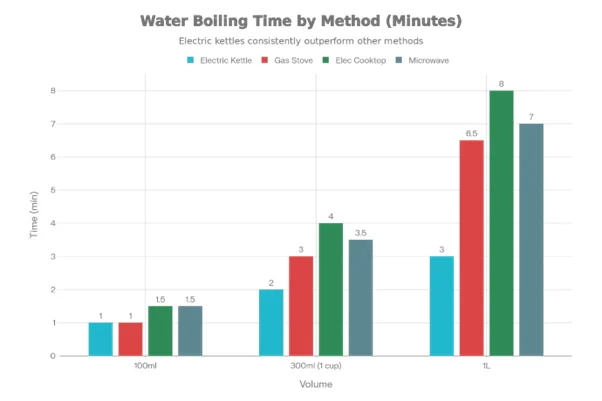 It takes 5 to 7 minutes* to boil a litre of water on a gas stove in a traditional stovetop kettle. At 100 millilitres, both methods take about a minute. But at 400 millilitres – roughly the amount you need for a cup of tea – the electric kettle boils the water in two minutes, while the gas kettle takes three. That’s a 50% time difference.
At one litre, the electric kettle boils water 1.5 minutes faster than the gas stovetop.
This matters in everyday life. Think of someone who makes hot drinks twice a day. Using an electric kettle saves three minutes every day. Over a year, this saves over eighteen hours.
Add in the time savings of making instant noodles, oatmeal, or soup. For those who work from home or lead busy lives, this speed translates directly into convenience.
The Impact of An Electric Kettle on Morning Routines
For a busy individual, morning time is precious. You wake up and have thirty minutes before work starts. An electric kettle that boils water in two minutes means your morning coffee is ready while you’re making breakfast or checking your emails.
Whereas a kettle on the gas stove takes six minutes, and when you’re in a hurry, those four extra minutes feel like an hour.
Safety Features That Protect Your Home and Family
Safety is where electric kettles show a real advantage over stovetop models.
Most electric kettles have an automatic shut-off feature. When the water starts boiling, the kettle detects the steam and automatically turns off. This prevents two common hazards: leaving the kettle on and forgetting it, and dry boiling, which occurs when all the water evaporates and the heating element overheats.
The exterior of the expensive electric kettle remains cool to the touch in most models. This is essential for homes with children or elderly family members. In comparison, a stovetop kettle heats the entire pot, including the exterior, which remains hot long after it stops boiling.
Electric kettles also have heat-resistant handles. These are designed so you can hold them securely without burning your fingers.
Many models have a secondary safety layer. If the automatic shut-off doesn’t work, a thermal fuse inside the kettle serves as a backup. This cuts off the power before the kettle reaches a dangerous temperature.
These features mean you can leave the kitchen with the kettle on. You don’t have to be on guard, and there’s no risk of forgetting the boiling pot.
Beyond Boiling Water: Daily Uses That Simplify Your Routine
An electric kettle is more useful than its name suggests.
Yes, it boils water for tea and coffee. But it also prepares:
- Instant meals. Pour boiling water over instant noodles, oatmeal, or soup. Wait three minutes, eat, and no stove is needed. This saves time and limits the dishes you need to wash.
- Baby formula. Many parents use electric kettles to heat water to safe temperatures for baby feeding bottles. Some expensive models can set specific temperatures, and they let you choose between 60°C and 100°C. This allows you to prepare the formula at the right heat without burning your child’s mouth.
- Pasta and rice. Boiling water in a kettle and pouring it into a pot with pasta or rice is faster than waiting for a pot to heat on the stove.
- Blanched vegetables. Boiling water in a kettle to blanch vegetables takes less time and uses less energy than heating a large pot on the stove.
- Cleaning and sanitising. Many homes use boiling water from a kettle to sterilise baby milk bottles, dishwashing utensils, or kitchen surfaces. The speed of an electric kettle makes this task quick and easy.
- DIY spa treatments. Hot water for a facial steam or foot soak can be obtained directly from the electric kettle, making wellness routines at home easier.
This versatility means one appliance handles multiple kitchen tasks. For people living in small spaces or without full kitchen setups, an electric kettle is almost essential.
Energy Efficiency of An Electric Kettle: What the Numbers Show?
 Energy efficiency is measured by (Output/Input x 100%), the ratio of useful heat to total energy used.
Gas stoves, which convert natural gas to heat, have efficiency rates around thirty to thirty-five per cent. Much heat escapes into the room. The rest goes into boiling water.
Electric kettles reach eighty to ninety per cent efficiency. The metal heating element transfers almost all its heat directly into the water.
This is why heating three litres of water in an electric kettle uses the same energy as heating one litre on a gas stove.
How to Further Reduce Kettle Energy Use
You can reduce your electric kettle’s energy consumption with a few simple steps:
- Fill only as much as you need. If you only need one cup of hot water, don’t fill the kettle to its full capacity. Boiling 200 millilitres of water requires significantly less energy than boiling 1.8 litres.
- Clean it regularly. Hard water can cause limescale to build up in electric kettle‘s base. These mineral deposits reduce can heating efficiency of your kettle. Cleaning your kettle with white vinegar or lemon juice every three months will remove this buildup. A clean kettle can boil faster and uses less electricity.
- Choose the right model. Higher wattage kettles (2,500 watts) boil faster but consume more electricity. Medium-wattage kettles (1,500 watts) boil more slowly but use less energy overall over time. Choose an electric kettle according to your patience and schedule.
- Use the temperature control. If your kettle has a temperature adjustment setting, set the water to only the temperature you need. Heating water to 70°C for baby formula requires 33 per cent less energy than boiling it to 100°C.
- Keep a kettle at your workplace or office. Having a kettle readily available means you won’t need to use shared facilities or wait for hot water from a continuously running dispenser.
Convenience Features of Electric Kettles That Change Your Routine
Modern electric kettles come with features that add real value to everyday use:
- Automatic shut-off. After the water boils, the kettle switches off automatically. You don’t have to remember to turn it off or worry about it drying out. For this reason alone, kettles are safer and more convenient than stovetop cooking.
- Keep-warm function. Some kettles can keep water at your chosen temperature for hours without using much energy. This means you always have hot water ready without having to reheat it repeatedly.
- Temperature presets. High-end models allow you to select specific temperatures for different drinks—green tea is brewed at 70°C. Coffee requires 95°C. The kettle heats up to the exact temperature and turns off, saving energy and improving the quality of the drink.
- Cordless design with a rotating base. Fill the kettle with water, place it on the base, and press the button. No hassle of cord tangles. No need to reach far in the kitchen. The 360-degree rotating base means you can hold the kettle at any angle.
- Water level indicator. A clear window shows how much water is inside. This helps you fill the right amount of water, preventing over- or under-watering.
- Cool-touch exterior. Even when the water inside boils, the outside remains cool. This is especially important in homes with children.
These features are not luxuries. These simply improve how easily an electric kettle fits into your life.
Comparison: Electric Kettle vs. Other Methods
How does an electric kettle compare to other ways of boiling water?
- Electric kettle versus gas stove. An electric kettle boils water faster and uses less energy. While a gas stove takes 5 to 7 minutes, an electric kettle takes only 2 to 3 minutes. This difference in energy consumption is significant: an electric kettle uses roughly half to one-third as much energy as a gas stove for the same amount of water.
- Electric kettle versus microwave. Although a microwave can heat water, it is less efficient than an electric kettle. A microwave achieves approximately 65% efficiency. An electric kettle reaches eighty to ninety per cent. The microwave also heats the container, wasting energy, while the electric kettle heats only the water.
- Electric kettle versus stovetop kettle on an electric cooktop. Both are electric, but the electric kettle is faster and more efficient. A stovetop kettle on an electric cooktop takes longer to heat up. The cooktop heats the pot, which then heats the water. The electric kettle heats the water directly.
- The conclusion is clear: for most households, the fastest and most efficient way to boil water is with an electric kettle.
How to Choose the Right Electric Kettle for Your Needs
Not all electric kettles are build equally. Selecting the best electric kettle depends on your household and needs.
- For frequent users: If you boil water several times a day, choose a large-capacity kettle with a keep-warm function. The 1.8-litre capacity means fewer refills and boiling. The keep-warm setting keeps hot water ready for you without needing to reheat it.
- For busy mornings. A high-wattage electric kettle that boils water in less than 3 minutes* is worth the extra power. When minutes matter for you, then speed saves time.
- For smaller families: A compact, small-capacity kettle uses less electricity and takes up less counter space. A 0.5 to 1-litre model is sufficient for one or two people.
- For homes with children, prioritize safety: always buy an electric kettle that has features like automatic shut-off, cool-touch exterior, and cordless design. Avoid all those models with exposed heating elements.
- For energy-saving users. The vacuum-insulated kettle keeps water hot for up to eight hours even without electricity. If you boil water once and drink it throughout the day, this design significantly reduces electricity use.
- Those who need temperature control: If you brew different types of tea or prepare baby formula, it’s worth investing in a kettle with adjustable temperature presets. It saves electricity by heating only to the temperature you need.
How to Switch from a stovetop to an electric kettle: Practical Steps
Switching from a stovetop kettle to an electric one can be easy. Here are a few steps to make the transition even smoother.
- Start with one kettle. You don’t need to replace everything at once. Get a standard electric kettle for your kitchen; it doesn’t have to be expensive. Use it first for your morning tea or coffee. And notice the difference in time and convenience.
- Learn the features. Briefly read the manual for your electric kettle’s brand and model. Understand how the automatic shut-off works, how to fill it, and whether it has temperature control. Most kettles are easy to use, but knowing the basics will help you get the most out of them.
- Change your habits. With an electric kettle, you no longer need to watch for steam or listen for a whistle. It will shut off automatically when the water boils, so let go of your old habits. The new habit is much easier.
- Keep it in a convenient place. Keep your kettle on the counter, not in a cupboard. Easy access means you’ll use it more often, leading to greater savings and convenience.
- Clean it regularly. Every three months, fill the kettle with equal parts water and white vinegar. Boil it, let the water sit for fifteen minutes, drain it, and rinse thoroughly. This formula removes mineral deposits and restores the kettle’s efficient operation.
Conclusion
An electric kettle is not glamorous. It does not change your life in dramatic ways. But it saves you money, time, and effort every single day.
You boil water for tea, coffee, instant meals, and countless other tasks. An electric kettle does this faster than any other method. It uses less electricity than a gas stove. It switches off automatically, making your kitchen safer. It has no learning curve. You fill it, press a button, and it works.
Over a year, those small time savings add up. Over five years, the energy savings accumulate. Over a decade, the convenience becomes second nature.
If you have not tried an electric kettle, the case is clear. They are affordable—most cost between fifteen and forty dollars. They last years. They work reliably. And they make your daily routine just a little bit easier, a little bit cheaper, and a little bit faster.
That is worth the switch.
Freelance Writer and Product Tester
Successfully works with creative teams by coordinating schedules and various creative inputs to craft unique stories and product review articles across multiple platforms. Bethany is responsible to tune with our technical team and write their real experiences about the various tested products.




Related Products


Best Electric Kettle Newsletter
Get exclusive articles, recommendations, shopping tips, and sales alerts
Contact Us